Did you find what you needed?

SCROLL

Internet Explorer is not supported.

It is recommended that you view this website on the latest version of Chrome, Edge, Firefox or Safari.

A Provincial Approach to Calculate and Track Health System Emissions

Back to Resources


BC health organizations establish a standardized calculator to reduce emissions across our health-care system


Once fully implemented, the Emissions Calculator will enable streamlined processes to:

  • Understand the unique sources of greenhouse gas emissions generated by health-care operations;
  • Identify high-impact opportunities to advance climate action and planetary health;
  • Reduce costs through increased efficiencies and data-supported decision making.


How does a standardized calculator help reduce greenhouse gas emissions?

  • Health-care operations generate greenhouse gases from many sources that include anesthetic gases, purchased goods and services such as medical supplies and equipment, energy use in buildings and more.
  • Until now, health organizations have tracked emissions from four of these sources (buildings, fleet, paper and refrigerants), as legislated requirements for reporting. Learn more about health-care emissions.
  • With a more complete understanding of health-care emission sources, we can better identify and prioritize the ones with the biggest impact, to advance climate action goals.
  • Until now, each B.C. health organization used informal methods to calculate emissions, beyond the four legislated sources. This prevented a standardized baseline across the province and led to gaps and inconsistencies in measurement.
  • With a common methodology and calculator, B.C. health organizations are able to share resources, reduce duplication and work effectively together.
  • With a more complete picture and shared tools, we will be better able to:
    • Make strategic decisions about where to focus reduction efforts;
    • Track the effectiveness of reductions and make improvements over time;
    • Celebrate successes and share learning with others in B.C., across Canada and beyond.

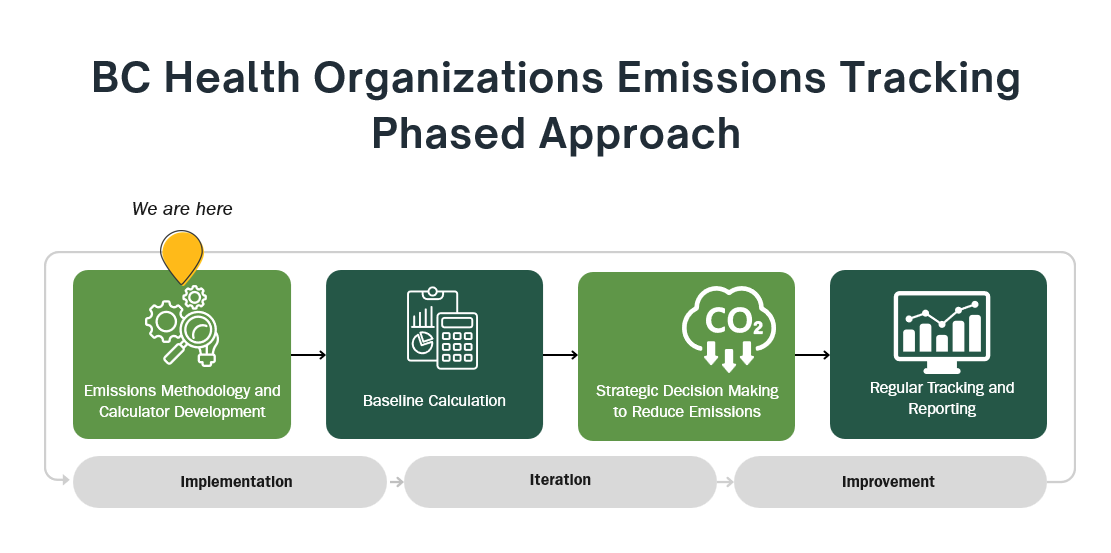
A phased approach

The project will roll out in phases, allowing each health organization time to build on a strong foundation, incorporate new approaches as needed and improve the calculator over time.
Who is involved?

A working group with representatives from all seven B.C. health organizations leads the development of the calculator, with support from a task group. Working group members contribute expertise in sustainability and emissions reporting, procurement, organizational transformation, and strategy. B.C.’s Ministry of Health funded the calculator’s foundational development phase and continues to engage as needed.

 

B.C. health organizations leading the development of the emissions calculator.

Questions?

For more information about this project and next steps, contact the Provincial Emissions Methodology Working Group co-facilitators:
Sonja.janousek@vch.ca, Director of Environmental Sustainability, Energy and Environmental Sustainability Team

Emily.lomax@vch.ca, Regional Sustainability Consultant, Energy and Environmental Sustainability Team