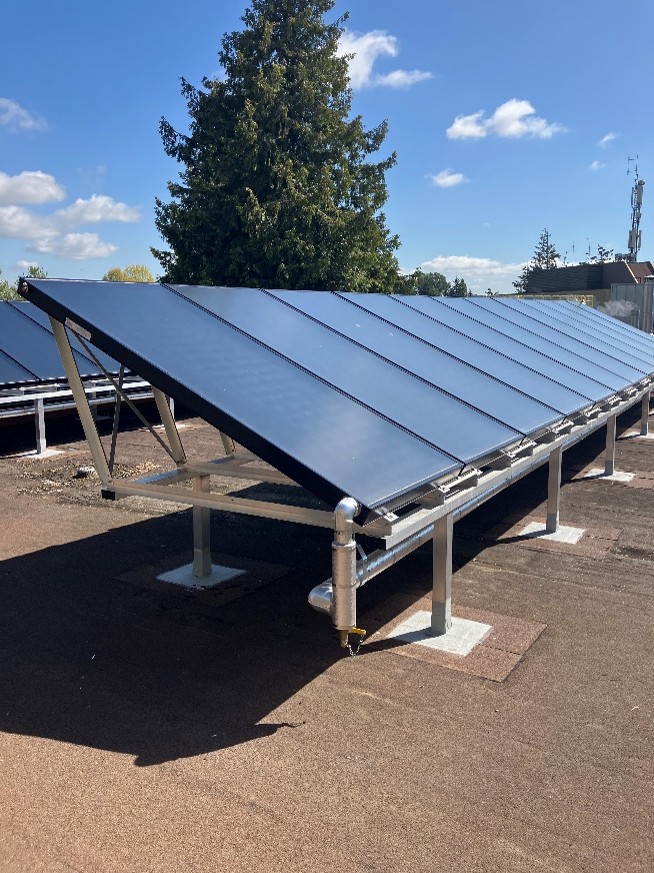
With sites chosen carefully and data monitored on-site, a solar thermal energy pilot has scaled into something more substantial.
When Fraser Health began installing solar thermal panels at its health care facilities, the objective was straightforward: leverage renewable energy to support domestic hot water production, reduce reliance on natural gas, and lower emissions. In addition to reducing natural gas consumption, the systems also help extend the service life of domestic hot water boilers by decreasing their heating load.
Solar thermal systems are relatively simple. They capture heat from sunlight through collector panels to preheat municipal potable water before it reaches gas-fired boilers. To ensure the technology works effectively, the energy team integrated performance monitoring into the system controls, enabling continuous data logging and analysis by engineering consultants. This approach eliminated the need for physical inspections or dedicated metering, minimizing operational burden in busy hospital environments.
By carefully assessing sites in advance and monitoring the panels’ performance over time we’ve been able to make informed decisions about where and how to scale this technology for maximum impact” — Jeson Mak, Energy and Emissions Director, Fraser Health
Solar thermal panels at Delta Hospital have now been in operation long enough to provide robust performance data. Results show that the technology is performing reliably—and in some cases exceeding expectations.

The use of solar thermal panels has expanded steadily from their initial installation at Delta Hospital to Eagle Ridge Hospital, Langley Memorial Hospital, Peace Arch Hospital, and most recently, Queens Park Care Centre. Sites are selected through energy modelling studies that assess solar potential, roof suitability, proximity to mechanical rooms, and domestic hot water demand—ensuring investments are targeted where they deliver the greatest benefit.
Since 2024, installations across Fraser Health have collectively achieved nearly 12,000 GJ in natural gas savings and avoided approximately 600 tonnes of CO₂e emissions, equivalent to eliminating emissions from 201 passenger cars.
The technology is highly effective, requires minimal maintenance, and has delivered greater-than-expected energy savings, even under variable weather conditions.” — Maleeka Aamer, Energy and Emissions Project Manager, Fraser Health
With demonstrated performance data in hand, the energy team now plans to expand solar thermal installations to additional Fraser Health sites as budget allows, turning a well-monitored pilot into a scalable program with measurable, compounding benefits for years to come.